

How does Adderall work in the brain? Adderall affects the activity of two important chemical messengers dopamine and norepinephrine that help regulate attention, motivation, alertness and impulse control. It is a prescription stimulant used primarily to treat attention-deficit/hyperactivity disorder (ADHD) and, for certain formulations, narcolepsy.
Adderall contains a combination of amphetamine and dextroamphetamine. These medicines influence how nerve cells communicate, which can help some people with ADHD manage symptoms such as distractibility, impulsivity and difficulty sustaining attention. However, its effects vary between individuals, and it can also cause side effects or serious complications.
Understanding how Adderall affects the brain helps explain both its potential benefits and its risks. This guide explores the science behind the medication, its effects on neurotransmitters, what people may experience during treatment, and the safety precautions that matter.
Quick Answer: How Does Adderall Work in the Brain?
Adderall works by increasing the availability and activity of dopamine and norepinephrine in the central nervous system. These neurotransmitters help nerve cells communicate and play roles in attention, motivation, alertness and executive function. In people with ADHD, this action may improve the ability to concentrate, control impulses and manage everyday tasks. The medication does not work the same way for everyone, and its effects depend on factors such as the prescribed formulation, individual response and medical history.
What Is Adderall?
Adderall is a prescription medication containing mixed amphetamine salts: amphetamine and dextroamphetamine. It belongs to a class of medicines called central nervous system stimulants.
It is commonly prescribed as part of a broader treatment plan for ADHD. Certain Adderall formulations are also approved for narcolepsy, a condition involving excessive daytime sleepiness and sudden sleep episodes. The approved uses depend on the specific product and its prescribing information.
ADHD can affect attention, planning, impulse control, activity levels and the ability to manage tasks. These symptoms are not simply a matter of laziness or a lack of willpower. ADHD involves complex differences in brain development and functioning, alongside genetic and environmental influences.
Adderall does not cure ADHD. Instead, it changes neurotransmitter activity in ways that may help reduce certain symptoms while the medicine is active.
The U.S. National Library of Medicine provides detailed information about the medication, approved uses, administration and potential risks in its Adderall drug information guide.
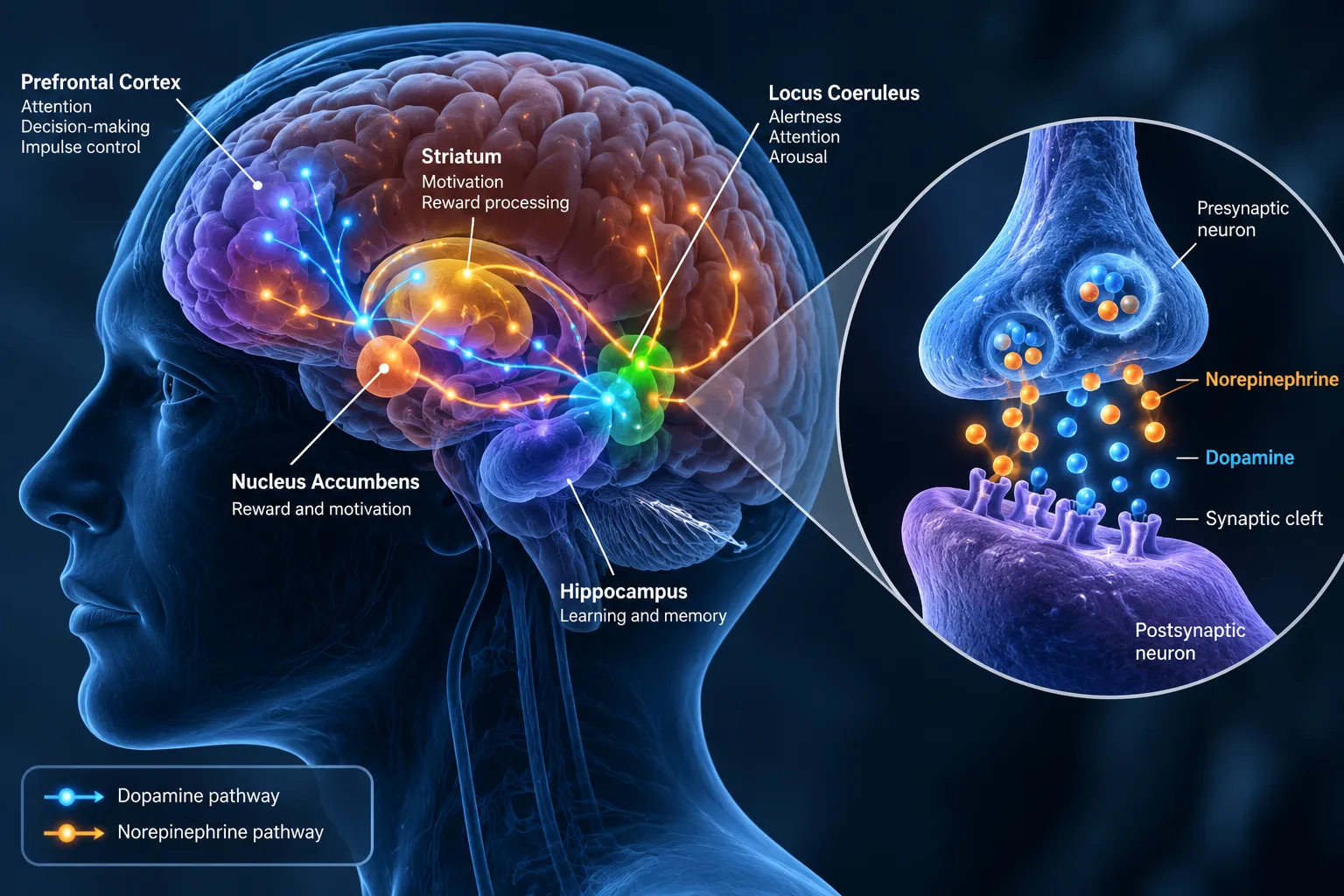
How Does Adderall Work in the Brain?
To understand how Adderall works in the brain, it helps to look at how neurons communicate.
The brain contains billions of nerve cells called neurons. These cells send and receive signals through electrical activity and chemical messengers known as neurotransmitters. Dopamine and norepinephrine are two neurotransmitters involved in attention, motivation, alertness and other mental processes.
When a neuron releases a neurotransmitter, the chemical crosses a tiny gap called a synapse and interacts with receptors on another cell. The signal is then regulated through several processes, including the reuptake of neurotransmitters into nerve cells.
Adderall changes this signaling system. Amphetamine medicines can increase the release of dopamine and norepinephrine and influence the transporters responsible for moving these chemicals between neurons. The result is increased neurotransmitter activity in certain brain pathways.
This process may help improve attention and reduce impulsivity in people with ADHD. However, the exact effects depend on several interacting brain systems. Scientists do not explain ADHD or Adderall’s effects through a single chemical imbalance.
1. Adderall Influences Dopamine Signaling
Dopamine plays a role in motivation, learning, reward processing and the ability to sustain effort toward a goal. It also contributes to aspects of attention and executive functioning.
Adderall increases dopamine signaling by affecting its release and transport. In relevant neural pathways, this can change how strongly and how long dopamine-related signals operate.
For some people with ADHD, these changes can make it easier to remain engaged with a task, follow instructions or resist distractions. That does not mean dopamine is simply a “focus chemical,” nor does it mean that more dopamine is always better. Brain function depends on where, when and how neurotransmitters act.
2. Adderall Influences Norepinephrine Signaling
Norepinephrine helps regulate alertness, attention and responses to information. It is involved in how the brain identifies relevant signals and responds to changing demands.
By increasing norepinephrine activity, Adderall may help some people maintain attention and manage competing distractions. It can also increase physiological arousal, which partly explains why some people experience a faster heartbeat, nervousness or difficulty sleeping.
The intended therapeutic effect is not unlimited stimulation. It is symptom improvement at a medically appropriate dose, balanced against side effects.
3. Adderall Changes Communication Between Neurons
Neurotransmitters help different brain networks coordinate their activity. Adderall’s effects on dopamine and norepinephrine can influence circuits involved in planning, working memory, attention and impulse control.
These changes may support everyday functions such as:
- Following a conversation without losing track of it.
- Starting and completing tasks.
- Maintaining attention during repetitive activities.
- Pausing before acting on an impulse.
- Organizing steps toward a goal.
These are possible treatment benefits, not guaranteed outcomes. Some people experience substantial improvement, while others have limited benefit or side effects that make the medication unsuitable.
The Role of Dopamine and Norepinephrine
Dopamine and norepinephrine are central to understanding the effects of Adderall. Although they interact, they have overlapping but distinct roles.
| Neurotransmitter | Major functions | Possible relevance to ADHD treatment |
| Dopamine | Motivation, reward learning, movement and aspects of attention | May support task engagement and aspects of executive function |
| Norepinephrine | Alertness, attention and responses to important information | May help with sustained attention and managing distractions |
What Is Dopamine?
Dopamine is involved in how the brain learns from experiences, evaluates rewards and motivates behaviour. It also contributes to movement and several other functions.
Dopamine is sometimes described online as the brain’s “pleasure chemical,” but that description is incomplete. Its role is broader than pleasure, and dopamine activity varies across different pathways.
Adderall’s effects on dopamine may help certain people with ADHD manage attention and motivation-related difficulties. However, it does not automatically create better habits, improve judgment or make every task enjoyable.
What Is Norepinephrine?
Norepinephrine contributes to alertness and the brain’s ability to prioritize incoming information. It also plays a role in the body’s stress and arousal responses.
Increasing norepinephrine activity may help improve certain aspects of attention, but excessive stimulation can contribute to anxiety, restlessness and sleep problems.
Is ADHD Caused by Low Dopamine?
ADHD should not be reduced to the idea that a person simply has “too little dopamine.” Research points to a complex condition involving genetics, brain development, neural networks and multiple biological processes.
Stimulant medications can improve symptoms by changing neurotransmitter signaling, but a positive response to Adderall does not prove that someone has ADHD. Diagnosis requires a qualified healthcare professional to assess symptoms, history, impairment and other possible explanations.
How Adderall Affects Focus and Attention
One of the main reasons Adderall is prescribed for ADHD is its potential to improve attention and impulse control.
Attention is not one single ability. It includes staying focused over time, shifting attention when needed, ignoring irrelevant information and keeping information in mind while completing a task.
Buy adderall online and adderall may affect several of these functions th3rough its influence on neurotransmitter signaling.
Sustained Attention
Sustained attention means remaining engaged with an activity over time. People with ADHD may find that their attention drifts during meetings, reading, schoolwork or other tasks.
When effective, Adderall may make it easier to stay with an activity and return to it after interruptions.
Impulse Control
Impulse control involves pausing to consider an action before responding. Some people taking Adderall as prescribed report improvements in interrupting less frequently, waiting their turn or thinking through a response.
The medication does not eliminate impulsivity for everyone, and its effects may be more noticeable in some situations than others.
Executive Function
Executive function includes planning, organizing, working memory and managing multi-step activities. Adderall may help some people manage tasks that previously felt difficult to start or sustain.
However, medication is not a substitute for practical supports. Calendars, routines, coaching, behavioural strategies and appropriate educational or workplace accommodations may also be valuable.
Why Does Adderall Affect People Differently?
People differ in their symptoms, biology, sleep patterns, medical histories and responses to medication. Other medicines, anxiety, mood disorders, cardiovascular conditions and substance use can also influence the overall experience.
For this reason, the same prescribed product may help one person substantially while causing uncomfortable side effects in another. A clinician evaluates benefits and risks rather than assuming that everyone will respond identically.
What Happens in the Brain After Taking Adderall?
After an oral dose, the medication is absorbed into the body and reaches the brain through the bloodstream. The timing and duration of its effects depend on the formulation, individual metabolism, food and other factors.

The following stages describe the general process, not a precise schedule for every person.
Stage 1: Absorption
After the medicine is swallowed, it passes through the digestive system and is absorbed into the bloodstream. The medication’s concentration changes over time as the body absorbs and processes it.
Immediate-release and extended-release formulations have different delivery characteristics.
Stage 2: Changes in Neurotransmitter Activity
Once the active ingredients reach the brain, they influence dopamine and norepinephrine signaling. These changes can affect neural pathways involved in attention, alertness and impulse control.
The effects are not limited to one small area of the brain, and the response is not identical across all neural networks.
Stage 3: Possible Changes in Symptoms
If the medicine is effective for an individual, improvements may become noticeable in areas such as attention, task completion or impulse control. Some people may also notice increased alertness.
Feeling unusually energetic or euphoric is not a requirement for treatment to work. Strong stimulation, agitation or an intense change in mood should not automatically be interpreted as a desirable effect.
Stage 4: The Body Processes the Medication
The body gradually metabolizes and eliminates the medicine. As its concentration changes, its noticeable effects may decrease.
The timing varies by formulation and individual. Patients should follow their prescription instructions rather than changing the schedule based on how they feel.
Immediate-Release vs. Extended-Release Adderall
Adderall is available in immediate-release and extended-release formulations. These forms deliver the active ingredients differently, which influences the timing of their effects.
| Feature | Immediate-release (IR) | Extended-release (XR) |
| Delivery | Releases medication more quickly | Designed to release medication over a longer period |
| Dosing schedule | May involve more than one dose per day, as prescribed | Commonly designed for once-daily use, as prescribed |
| Duration | Generally shorter than XR | Generally longer than IR |
| Main consideration | Timing of doses and changes in effect | Longer coverage and potential impact on sleep |
| Important note | Follow the exact prescription instructions | Follow product-specific instructions; do not crush or chew capsules unless the product information explicitly permits a particular method |
Neither formulation is universally better. A clinician considers symptom patterns, daily schedule, tolerability, medical history and other medicines when selecting a treatment.
Do not substitute one formulation for another or change the dose without professional guidance. Different products can have different release characteristics even when their ingredients are related.
How Long Do Brain Effects Last?
The duration of Adderall’s effects depends on whether the person takes an immediate-release or extended-release formulation, along with individual factors such as metabolism and other medicines.
Immediate-release products generally have a shorter effect window, while extended-release products are designed to provide longer coverage. These descriptions are general and should not be used to calculate a personal dosing schedule.
It is also important to distinguish between the period when a person notices benefits and the time required for the body to eliminate the medicine. These are not necessarily the same.
If symptoms return before the next scheduled dose, or if effects last longer than expected, discuss the pattern with the prescriber. Do not take extra medication or change the timing on your own.
Common Side Effects and Brain-Related Effects

Adderall affects the central nervous system, so it can influence both mental and physical functioning. Side effects vary, and some people experience few problems while others find them disruptive.
Common side effects may include:
- Difficulty falling asleep or staying asleep.
- Reduced appetite or weight loss.
- Dry mouth.
- Headache.
- Nervousness or anxiety.
- Irritability.
- Increased heart rate or blood pressure.
- Stomach discomfort.
Some side effects may improve as a clinician adjusts the treatment plan, but patients should not assume that persistent or worsening symptoms will resolve without help.
Why Can Adderall Cause Anxiety or Restlessness?
The same neurotransmitter systems involved in attention also contribute to alertness and arousal. For some people, increased stimulation can feel like nervousness, agitation or restlessness.
Tell the prescriber if anxiety becomes intense, mood changes are unusual or the medication seems to make daily functioning worse. Do not try to manage significant side effects by changing the dose independently.
Why Can Adderall Affect Sleep?
Stimulant activity can make it harder to fall asleep, particularly when the medication’s effects extend into the evening. Poor sleep can then affect concentration, mood and daily performance.
Follow the prescribed schedule and discuss persistent sleep problems with a healthcare professional. Do not take additional doses to compensate for tiredness.
Serious Symptoms That Need Urgent Attention
Seek urgent medical care for symptoms such as chest pain, difficulty breathing, fainting, seizures, severe confusion, hallucinations or a dangerously fast or irregular heartbeat. Severe agitation or signs of a serious allergic reaction also require urgent assessment.
For suspected overdose, contact local emergency services or a poison information service immediately. Do not wait for symptoms to worsen.
Long-Term Use, Tolerance and Dependence
Questions about long-term brain effects are important because Adderall is a controlled prescription stimulant with a recognized risk of misuse, dependence and addiction.
When prescribed and monitored appropriately, stimulant medication can be an effective treatment for some people with ADHD. However, it is not risk-free, and continued treatment should be reviewed periodically.
Can the Brain Become Tolerant to Adderall?
Tolerance refers to a reduced response to a medication after repeated exposure. It does not occur in the same way or to the same extent for everyone.
If a previously helpful treatment seems less effective, several explanations are possible, including changes in symptoms, sleep, stress, other health conditions or medication response. A clinician can assess these factors and decide whether the treatment plan needs to change.
Do not increase the dose to try to recreate an earlier feeling or stronger effect.
Is Dependence the Same as Addiction?
No. Physical dependence means the body has adapted to a medication and may react when it is reduced or stopped. Addiction involves a pattern of compulsive use despite harmful consequences.
These concepts are related but not interchangeable. Taking medication exactly as prescribed does not automatically mean a person is addicted, but prescription stimulants can still carry risks that require monitoring.
Do not stop or alter long-term treatment without discussing it with the prescriber. Abrupt changes, particularly after misuse, can be associated with fatigue, low mood or other withdrawal-related symptoms.
Can Misusing Adderall Harm the Brain or Body?
Taking more than prescribed, using someone else’s medication or using unapproved routes can increase the risk of serious harm. Misuse can lead to dangerous cardiovascular effects, severe agitation, psychiatric symptoms, overdose and death.
The U.S. Food and Drug Administration warns about misuse, addiction, overdose and the importance of not sharing prescription stimulants. See the FDA’s prescription stimulant safety information.
Who Should Use Extra Caution?
Adderall is not appropriate for everyone. Before prescribing it, a healthcare professional needs to understand the patient’s health history, current medicines and relevant risk factors.
Extra caution or additional assessment may be needed for people with:
- Heart disease, significant cardiovascular problems or high blood pressure.
- A history of bipolar disorder, psychosis or other serious psychiatric symptoms.
- A history of substance misuse or stimulant misuse.
- Medicines or supplements that may interact with stimulant treatment.
- Significant sleep difficulties or severe anxiety.
- Pregnancy or breastfeeding, where an individualized risk-benefit discussion is needed.
This list is not exhaustive. The appropriate decision depends on the individual and the specific product’s prescribing information.
Can Adderall Be Taken With Other Medicines?
Some medicines can interact with amphetamine-based stimulants. Certain antidepressants, medicines that affect blood pressure and other stimulants may require particular attention. Monoamine oxidase inhibitors are especially important because of the risk of serious interactions.
Provide your prescriber and pharmacist with a complete list of prescription medicines, over-the-counter products and supplements. Do not start, stop or combine medicines based solely on information found online.
Safe Use and Important Precautions
Safe treatment involves more than understanding how Adderall affects neurotransmitters. It also requires an appropriate diagnosis, a legitimate prescription and regular review.
Follow these basic precautions:
- Take it exactly as prescribed. Do not increase the amount, frequency or duration without your prescriber’s instructions.
- Do not share medication. A prescription is intended for the person named on the label.
- Store it securely. Keep it out of the reach of children and other people who could take it accidentally or misuse it.
- Attend follow-up appointments. Your healthcare professional may monitor symptoms, blood pressure, heart rate, sleep, appetite, weight and side effects.
- Discuss concerns early. Report changes in mood, sleep, appetite, heart symptoms or treatment effectiveness.
- Dispose of unused medication safely. Follow local pharmacy or medicine take-back guidance.
In the United States, Adderall is a Schedule II controlled substance. Laws differ by country, so patients should follow the rules and medical guidance applicable to their location.
The medication should be obtained through a legitimate healthcare and pharmacy pathway. Avoid unverified online sellers that offer prescription stimulants without the required prescription or medical oversight.
Frequently Asked Questions
1. How does Adderall work in the brain?
Adderall increases the activity and availability of dopamine and norepinephrine, neurotransmitters involved in attention, motivation and alertness. These effects may improve certain ADHD symptoms when the medicine is prescribed and monitored appropriately.
2. Does Adderall increase dopamine?
Yes. Amphetamine-based medicines such as Adderall can increase dopamine signaling by influencing neurotransmitter release and transport. Dopamine is involved in several functions, including motivation, reward learning and aspects of attention.
3. Does Adderall increase norepinephrine?
Yes. Adderall can increase norepinephrine activity as well. This neurotransmitter contributes to alertness, attention and responses to important information. Increased activity can also contribute to side effects such as nervousness or a faster heartbeat.
4. Does Adderall permanently change the brain?
It is not accurate to say that Adderall inevitably causes permanent brain changes in every person who takes it as prescribed. The effects of stimulant exposure depend on multiple factors, including dose, duration, individual biology and whether the medication is misused. Research into long-term effects continues. Discuss personal concerns with a qualified healthcare professional.
5. How quickly does Adderall work?
The timing varies by formulation and individual. Immediate-release and extended-release products have different delivery profiles. Follow the product instructions and your prescription rather than using a general online estimate to decide when to take another dose.
6. Why does Adderall help some people with ADHD focus?
By influencing dopamine and norepinephrine signaling, Adderall may help certain brain networks involved in attention, impulse control and executive function. The degree of improvement varies, and not everyone benefits from the same treatment.
7. Can Adderall make someone feel anxious or restless?
Yes. Anxiety, nervousness, irritability and restlessness are possible side effects. Contact the prescriber if these effects persist or interfere with daily life. Severe agitation, hallucinations or chest pain require urgent medical assessment.
8. Is Adderall immediate-release different from extended-release Adderall?
Yes. Immediate-release and extended-release formulations deliver medication differently and have different intended duration profiles. They should not be treated as interchangeable without guidance from the prescriber.
9. Can a person develop dependence on Adderall?
Yes. Adderall has a risk of misuse, dependence and addiction. Taking it differently from the prescription or using someone else’s medication increases the risk of harm. Regular clinical monitoring and secure storage are important.
10. Should someone change their Adderall dose if it stops helping?
No. Do not increase, reduce or change the timing of your dose independently. Contact the prescriber to discuss symptom changes, side effects, sleep, other medicines and whether the treatment plan needs review.
Conclusion
Understanding how Adderall works in the brain begins with dopamine and norepinephrine two neurotransmitters that contribute to attention, motivation, alertness and executive functioning. By changing their activity, Adderall may help some people with ADHD manage symptoms and improve everyday functioning.
However, its effects are not identical for everyone. The medicine can also cause sleep problems, appetite changes, anxiety, cardiovascular effects and more serious complications, particularly when misused.
The safest approach is to use Adderall only under appropriate medical supervision, follow the prescribed instructions and discuss any concerns with a qualified healthcare professional. Medication decisions should be based on an individual’s symptoms, health history and response not on the assumption that a stronger effect is always better.
Medical Disclaimer
This article is for general educational purposes and is not a substitute for professional medical advice, diagnosis or treatment. Do not start, stop or change a prescription medication without consulting a qualified healthcare professional. For urgent symptoms or suspected overdose, seek emergency medical assistance.
References
- MedlinePlus: Dextroamphetamine and Amphetamine
- U.S. Food and Drug Administration: Prescription Stimulant Medications
- U.S. Food and Drug Administration: Updated Warnings for Prescription Stimulants